GEO 101: How to Show Up in ChatGPT, Perplexity, and Claude
The digital landscape is shifting. While traditional SEO focuses on ranking blue links on a search results page, a new discipline has emerged: GEO (Generative Engine Optimization). If you want your brand to be recommended by AI, you need to optimize your content to be discoverable, authoritative, and extractable for AI response generation.
If you are wondering how to show up in ChatGPT or how to become a cited source in Perplexity, this guide covers the core strategies you need to know.

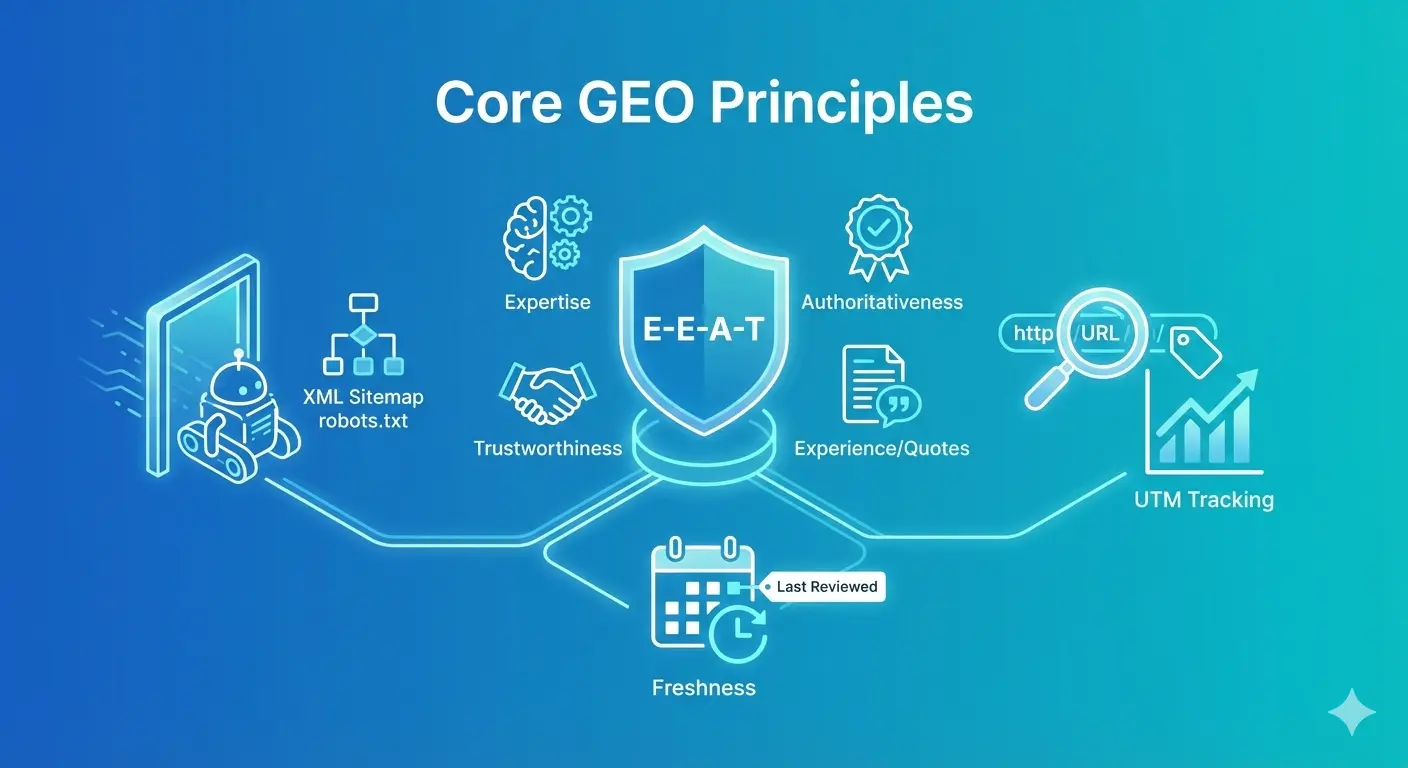
Core GEO Principles
Before diving into platform-specific tactics, you must establish a foundation that allows AI crawlers to access and trust your content.
-
Open the Gates: Ensure you allow AI crawlers access via open robots.txt files and XML sitemaps.
-
Establish E-E-A-T: AI engines prioritize Experience, Expertise, Authoritativeness, and Trustworthiness. Build credibility by using expert quotes, statistics, and clear source citations.
-
Maintain Freshness: AI models favor up-to-date information. Regularly update your content with "last reviewed" dates and new data to stay relevant.
-
Track Performance: Add UTM tags to your links to track referrals from AI tools specifically.
How to Show Up in ChatGPT
ChatGPT relies heavily on Bing for its real-time data access, requiring specific strategies distinct from Google-focused SEO.
-
Leverage Bing Webmaster Tools: To show up in ChatGPT, you must index your site with Bing Webmaster Tools to enable crawling.
-
Target High-Ranking Lists: Secure spots in high-ranking "best of" lists and directories on Google. These lists heavily influence recommendations, often carrying a 2:1 weight over user reviews.
-
Adopt Conversational Formats: Structure your content to mimic natural conversation. Use question-and-answer formats and scenario-based content that directly addresses user pain points.
Strategies for Perplexity Presence
Perplexity functions as an answer engine that cites its sources, making "verifiability" the key metric for success.
-
Prioritize Entity Signals: Strengthen your entity presence using Wikidata entries and FAQPage schema.
-
Optimize for RAG (Retrieval-Augmented Generation): Create content that is easy for the AI to retrieve and summarize, such as Q&A sections, short paragraphs, and "Best X for Y" lists.
-
Use Quotable Stats: Include data and statistics that are easy to extract to increase the likelihood of being cited.
-
Boost Third-Party Mentions: Perplexity favors credible sites; getting mentions from authoritative third-party domains can boost your visibility.
Optimizing for Claude
Claude is designed with specific safety filters and a massive context window, requiring a more analytical content approach.
-
Adopt a Neutral Tone: Avoid "salesy" language. Use a neutral, analyst-style tone to pass safety filters and appear objective.
-
Structure for Analysis: Use numbered steps, bullet points, logical frameworks, and data tables. This formatting helps Claude process and analyze your information effectively.
-
Go Long-Form: Leverage long-form, interconnected content with internal links to exploit Claude's large context window, allowing it to ingest more of your site's data at once.
Measuring Your GEO Success
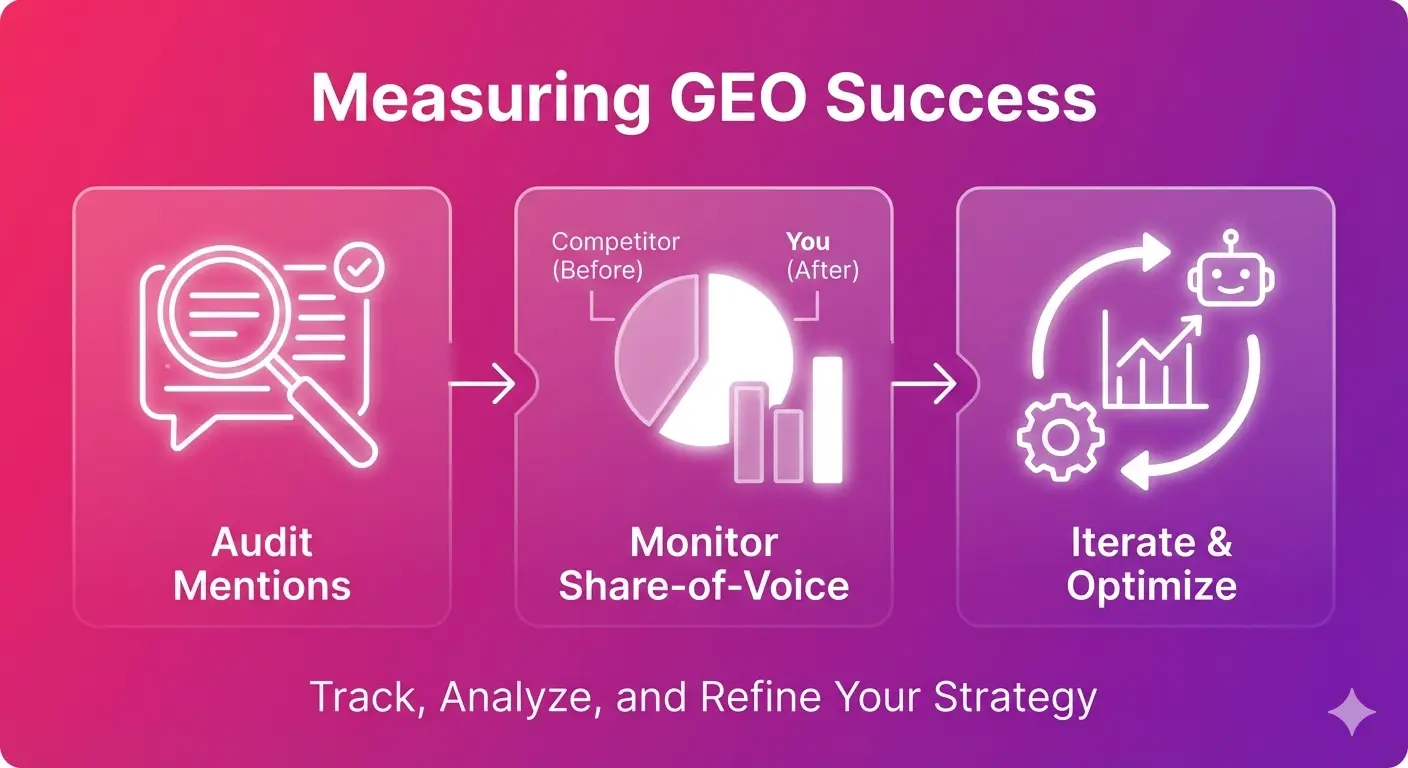
You can't improve what you don't measure.
-
Audit Mentions: Regularly audit how your brand is mentioned across different prompts.
-
Monitor Share-of-Voice: Compare your share-of-voice against competitors before and after optimization to gauge the impact of your GEO efforts.
-
Iterate: Use tools to monitor bot traffic and citation rates, adjusting your strategy as the AI models evolve.
Resources:
- How to Appear in ChatGPT – GenerateLeads
- Perplexity GEO Ultimate Guide – Geneo
- Generative Engine Optimization (GEO) Strategy Guide – First Page Sage
- Generative Engine Optimization Guide for ChatGPT, Perplexity, Gemini, Claude & Copilot – Passionfru.it
- Generative Engine Optimization (GEO) Tips – Stellar Content
- GEO – Jakob Nielsen's Substack
- How to Improve Visibility on Perplexity – Qwairy
- How to Rank in Claude AI: The Marketer's Guide to GEO – Nomadic Advertising
- Generative Engine Optimization (GEO) Guide 2025 – Profound
- GEO Growth Strategy: How to Get Recommended by AI Chatbots – ITO Action
- GEO Strategies – Meltwater
- Effective GEO Strategy for Perplexity AI – LSEO
- Eric Osiu on LinkedIn: How to Rank on Claude, Gemini, Perplexity
- YouTube: Generative Engine Optimization (GEO) Explained
- AI SEO / GEO Optimization Tools – Claude Fast
- Generative Engine Optimization – FunnelBoost Media
- Perplexity Stealth AI Crawling and Impacts on GEO – SEER Interactive
- Reddit r/ClaudeAI: Built a product with Claude Code to automate GEO
- Reddit r/GrowthHacking: Generative Engine Optimization (GEO) – Legit Strategy?
Ready to implement AI in your business? Get your free AI consultation and discover how AI can help you achieve significant productivity improvements.
Frequently Asked Questions
1. What is the main benefit of showing up in ChatGPT, Perplexity & Claude?
The primary benefit is capturing high-intent, zero-click traffic and buyer mindshare in the new era of conversational AI search, where users increasingly get direct answers from these tools instead of clicking through traditional Google results.
- Direct influence on decisions: When someone asks "best AI agency for business growth" or "how to scale marketing with AI agents" in ChatGPT, Perplexity, or Claude, a strong presence means your agency gets cited, recommended, or described positively — often as the authoritative source. This builds trust instantly without users ever visiting your site initially.
- Massive visibility multiplier: These platforms have enormous reach: ChatGPT alone sees hundreds of millions of weekly queries (with rapid growth in 2025–2026), Perplexity is exploding as the go-to for research-heavy searches, and Claude is favored by technical/enterprise users. Getting featured drives brand awareness, inbound leads, and even direct traffic when links are included (especially in Perplexity).
- Competitive moat: Most businesses still focus only on traditional SEO/Google. Being one of the few optimized for these AI engines creates a significant edge — you appear in answers where competitors don't, shaping perceptions early in the buyer's journey.
- Long-term authority signal: Consistent citations reinforce your brand as the "go-to" in AI responses, feeding back into better rankings across all platforms (including emerging Google AI Overviews synergies).
In short: It's about owning the conversation when decision-makers ask AI for advice, recommendations, or solutions turning passive search into proactive brand dominance and revenue growth.
2. How long does implementation typically take?
There are small things you can do today to set the foundation and amplify your presence on chatgpt and start showing results right away
Realistic timeline: 3–6 months for meaningful, measurable results (e.g., consistent citations in 20–40% of relevant queries), with noticeable early wins often in 6–12 weeks.
Breakdown by phase:
- Foundation & Audit: Weeks 1–4 Baseline tracking (using tools like visibility monitors), content audits, fixing technical issues (schema markup, crawlability, entity clarity), and quick authority boosts (e.g., listings in high-trust directories, review platforms). Early citations can appear here if your brand already has strong signals.
- Core Optimization: Months 2–3 Publishing/updating high-value content (thought leadership, case studies, structured guides), building topical authority clusters, strategic PR/backlinks from AI-favored sources (LinkedIn, G2, Reddit, YouTube), and iterative testing with prompts. This is when visibility typically jumps 2–5x on tested queries.
- Scaling & Refinement: Months 4–6 Monitoring competitors, refining based on what earns citations (e.g., statistics, unique insights, fresh data), expanding to multimedia (YouTube heavily cited), and automating tracking/reporting. Sustained presence solidifies here.
Factors that influence speed:
- Starting point — Strong existing SEO/domain authority, fresh/high-quality content, and mentions in trusted sources (G2, Clutch, LinkedIn) accelerate everything by 1–2 months.
- Industry/competition — Niche AI/agency topics move faster than saturated e-commerce; highly competitive queries take longer.
- Resource commitment — Consistent content publishing (2–4 pieces/month), PR outreach, and testing speed things up vs. passive approaches.
- Platform specifics — Perplexity often shows results quickest (real-time web access); ChatGPT/Claude rely more on training data signals, so changes compound over weeks/months.
We aim for transparent milestones at Superconscious.agency — expect weekly/bi-weekly reports showing citation share improvements.
3. What are the common challenges?
Here are the biggest hurdles agencies/brands face, plus practical ways we overcome them:
- No direct "Search Console" for AI Unlike Google, there's no official dashboard showing impressions/citations. Solution → Use third-party GEO tracking tools (e.g., ones monitoring ChatGPT, Perplexity, Claude responses in real-time), manual prompt testing on 20–50 key questions, and GA4 segments for AI-referral traffic. We set up custom dashboards for clients.
- Black-box algorithms & inconsistency Each model (ChatGPT conversational, Perplexity real-time/web-heavy, Claude more conservative/encyclopedic) favors different signals; results vary by prompt phrasing, location, or even day. Solution → Test across multiple phrasings/locations, focus on universal signals (E-E-A-T: Experience, Expertise, Authoritativeness, Trustworthiness), and prioritize content that's clear, statistic-rich, unique, and frequently updated. We build platform-specific tactics.
- Slow feedback loop Changes (new content, backlinks) can take weeks to influence model outputs, especially in ChatGPT/Claude's base knowledge. Solution → Layer quick wins (structured data/schema for entity recognition, fresh blog posts) with long-term authority (PR, directory listings, YouTube). Track progress weekly to stay motivated.
- Content quality bar is extremely high AI favors authoritative, well-cited, fresh, non-spammy sources; generic or salesy content gets ignored. Solution → Create genuinely valuable assets (original research, detailed case studies, benchmarks) with strong structure (headings, lists, stats, quotes). Avoid keyword stuffing — focus on answering questions better than anyone else.
- Resource intensity → Requires ongoing content, monitoring, and iteration — not "set it and forget it." Solution → We handle the heavy lifting (audits, content strategy, optimization sprints) while giving clients simple action items (e.g., claim listings, encourage reviews). Start small with 5–10 high-value queries.
Published by Superconscious AI Agency on 2026-01-27. For more AI insights, follow our AI Strategy Blog.