The COO's Blueprint: Building a No-Code AI Pipeline for Business Automation & Growth
As a business leader, you intuitively grasp that Artificial Intelligence (AI) is the ultimate accelerator for efficiency and intelligent decision-making. Yet, the journey from AI concept to real-world implementation often feels like navigating a dense technical jungle. How can you, a non-developer, construct a robust AI pipeline to automate critical business processes?

The answer is simpler than you think: You no longer need to be a coding expert.
Thanks to a groundbreaking wave of no-code and low-code tools, creating a secure, data-centric AI pipeline is now firmly within the grasp of any strategic leader. This comprehensive guide will demystify the entire process, providing a clear, actionable blueprint that empowers you to directly architect transformative change within your organization.
🔥 Why No-Code AI is an Imperative for Business Leaders
The landscape of AI adoption is rapidly shifting. Traditional barriers—complex coding, specialized talent scarcity—are dissolving. By 2025, experts predict that up to 70% of new business applications will leverage low-code or no-code technologies. This isn't just a trend; it's a fundamental, irreversible change in how businesses approach software and AI development.
 The no-code/low-code market is booming, projected to reach over $187 billion by 2025. This explosive growth is fueled by the urgent need for digital transformation and persistent talent shortages in AI and engineering. For operational leaders, this means no-code isn't a niche solution; it's a mainstream answer to critical challenges like accelerating time-to-market and overcoming hiring hurdles. You can now implement sophisticated AI solutions with your existing teams, often in days instead of months, directly alleviating common executive pain points.
Step 1: Strategically Define Your High-Impact Business Problem
Before diving into any technology, the most crucial first step is to precisely define the problem your AI pipeline will solve. An AI pipeline is a solution for a problem, not an end in itself. Focus on a single, high-impact use case where you can achieve a clear, measurable win. This approach minimizes risk and builds crucial internal confidence.
The success of no-code AI hinges on a disciplined, problem-centric approach. Identify repetitive tasks that require a degree of intelligence and nuance. Such strategic selection leads to early, tangible wins, vital for securing executive buy-in.
When choosing your first project, ask:
- What specific AI model will be trained?
- What data types and sources are necessary?
- What is the expected output, and how will it be used?
Ideal candidates for AI automation are tasks that are highly repetitive, follow consistent patterns, consume significant time, have clear inputs/outputs, and don't demand complex human judgment. Focusing on these tasks yields quantifiable efficiency gains.
Actionable Tip: Choose a specific, measurable goal, like "Reduce customer churn by 15% within six months," to keep your project focused and demonstrate immediate, tangible value.
Step 2: Demystifying the No-Code AI Pipeline Anatomy
Think of an AI pipeline as a digital factory assembly line. Raw materials (data) enter, are processed and transformed, and a finished product (an insight or action) emerges. No-code tools abstract this complexity into a logical, straightforward interface.
Ideal candidates are highly repetitive, follow consistent patterns, consume significant time, have clear inputs/outputs, and don't demand complex human judgment. Focusing on these tasks yields quantifiable efficiency gains, transforming AI from an abstract concept into a practical tool for concrete operational improvement.
A detailed pipeline includes these crucial stages:
- Data Collection & Ingestion: Gathering raw data from various business systems.
- Data Cleaning & Validation: Ensuring data quality, consistency, and readiness for analysis.
- Data Transformation & Feature Engineering: Preparing data for optimal AI model performance.
- AI Model Selection & Training: Applying AI models to clean data for pattern recognition or predictions.
- Model Evaluation & Deployment: Assessing model performance and integrating it into live systems.
- Monitoring & Feedback Loop: Continuously tracking performance and supporting ongoing improvement.
Step 2: Demystifying the No-Code AI Pipeline Anatomy
Think of an AI pipeline as a digital factory assembly line. Raw materials (data) enter, are processed and transformed, and a finished product (an insight or action) emerges. While the underlying technology is intricate, the stages are logical and straightforward. No-code tools abstract this complexity, presenting an intuitive interface.
While a simplified view involves four core stages, a more detailed understanding reveals crucial steps that no-code tools seamlessly handle:
Data Collection & Ingestion: Gathering raw data from various business systems. No-code platforms simplify these stages through intuitive, step-by-step guidance, enabling effortless data preprocessing, automated model training, and seamless deployment.
Data Cleaning & Validation: Ensuring data quality, consistency, and readiness for analysis.
Core AI Pipeline Stages & No-Code Tool Categories
Here are the essential tool categories for each stage of your pipeline:
Data Transformation & Feature Engineering: Preparing data for optimal AI model performance.
1. Data Ingestion
- Purpose: Collects raw data from various business systems.
- Tool Category: Universal Data Adapters & Connectors
- Example Tools: Airbyte, Databricks (bamboolib)
AI Model Selection & Training: Applying AI models to clean data for pattern recognition, predictions, or classifications.
2. Data Processing & Storage
- Purpose: Cleans, validates, transforms, and securely stores data for AI analysis.
- Tool Category: Cloud Data Warehouses & Data Prep Tools
- Example Tools: Snowflake, Google BigQuery, Astera
Model Evaluation & Deployment: Assessing model performance and integrating it into live systems.
3. AI Modeling
- Purpose: Applies AI models to clean data for pattern recognition, predictions, or classifications.
- Tool Category: AutoML Platforms & Pre-trained Model Hubs
- Example Tools: H2O.ai, Google Cloud Vertex AI, Hugging Face, DataRobot, Akkio
Monitoring & Feedback Loop: Continuously tracking performance, identifying errors, and supporting ongoing improvement.
4. Workflow Automation & Interface
- Purpose: Links AI outputs to business applications, triggering actions and providing a visual control panel for pipeline building.
- Tool Category: Workflow Automation Platforms & Visual App Builders
- Example Tools: n8n, Zapier, Bubble, Retool
No-code platforms simplify these stages through intuitive, step-by-step guidance, enabling effortless data preprocessing, automated model training with a single click, and seamless deployment. Understanding the purpose of each step—e.g., why data cleaning is vital for model reliability—empowers you to define requirements, evaluate solutions, and identify bottlenecks, even without coding. This elevates your role to an informed architect, enhancing strategic oversight.
| Pipeline Stage (Operational View) | Purpose | No-Code Tool Category | Example Tools |
|---|---|---|---|
| Data Ingestion | Collects raw data from various business systems. | Universal Data Adapters & Connectors | Airbyte, Databricks (bamboolib) |
| Data Processing & Storage | Cleans, validates, transforms, and securely stores data for AI analysis. | Cloud Data Warehouses & Data Prep Tools | Snowflake, Google BigQuery, Astera |
| AI Modeling | Applies AI models to clean data for pattern recognition, predictions, or classifications. | AutoML Platforms & Pre-trained Model Hubs | H2O.ai, Google Cloud Vertex AI, Hugging Face, DataRobot, Akkio |
| Workflow Automation & Interface | Links AI outputs to business applications, triggering actions and providing a visual control panel for pipeline building. | Workflow Automation Platforms & Visual App Builders | n8n, Zapier, Bubble, Retool |
| Monitoring & Iteration | Tracks pipeline performance, identifies errors, and supports continuous improvement. | MLOps & Monitoring Dashboards | ML Clever, Databricks Machine Learning |
5. Monitoring & Iteration
- Purpose: Tracks pipeline performance, identifies errors, and supports continuous improvement.
- Tool Category: MLOps & Monitoring Dashboards
- Example Tools: ML Clever, Databricks Machine Learning
Table 1: Core AI Pipeline Stages & No-Code Tool Categories
Step 3: Assemble Your Powerful No-Code Toolkit
The true power of a no-code AI pipeline lies in its ability to seamlessly connect pre-built tools.
Pipeline Stage (Operational View)
A. Data Ingestion: The Universal Adapters
These tools are the "on-ramps" for your data. Platforms like Airbyte offer hundreds of pre-built connectors to extract data from virtually any source (e.g., Salesforce, QuickBooks, Google Analytics) with just a few clicks.
Purpose
B. Data Storage: The Secure Central Hubs
Cloud-based data warehouses securely store and organize your data. Google BigQuery, for example, is designed to quickly ingest and aggregate data, and its BigQueryML feature simplifies predictions directly within the data warehouse.
No-Code Tool Category
C. AI Modeling: The "Brain-as-a-Service"
Instead of building models from scratch, you use AutoML tools or pre-trained models. AutoML platforms like H2O.ai and Google Cloud Vertex AI automate time-consuming data science tasks. Pre-trained model hubs like Hugging Face provide ready-to-use models, especially for Natural Language Processing (NLP).y
Example Tools
D. Workflow Automation: The Action Engines
These tools link AI insights to practical business applications. Platforms like n8n and Zapier can connect to Large Language Models (LLMs) like GPT-4, Claude, and Gemini, enabling AI agents to take decisive, context-aware action within your workflows.
Data Ingestion
E. Visual Interface: The Intuitive Control Panels
These platforms provide the drag-and-drop canvas for building your pipeline. Bubble, for instance, enables visual creation of scalable web and mobile apps that connect to powerful AI models in minutes.
Step 3: Assemble Your Powerful No-Code/Low-Code Toolkit
The true power of a no-code AI pipeline lies in its ability to seamlessly connect pre-built tools, abstracting away technical complexities. Here are the essential categories:
A. Data Ingestion: The Universal Adapters These tools are the "on-ramps" for your data. Platforms like Airbyte offer hundreds of pre-built connectors to extract data from virtually any source (e.g., Salesforce, QuickBooks, Google Analytics) with just a few clicks. Advanced versions even feature AI assistants that auto-fill configurations, further simplifying setup. This automation significantly lowers technical barriers, allowing your teams to connect data sources with minimal IT intervention, accelerating your AI initiatives.
B. Data Storage: The Secure Central Hubs Cloud-based data warehouses securely store and organize your data for AI analysis. Google BigQuery, for example, is designed to quickly ingest and aggregate data in various formats, allowing immediate use. BigQuery has evolved to include "embedded AI and model development" (BigQueryML), simplifying predictions directly within the data warehouse using familiar SQL. This streamlines the pipeline by bringing AI processing closer to the data source, translating to faster time-to-insight and reduced operational overhead.
C. AI Modeling: The "Brain-as-a-Service" Instead of building models from scratch, you use AutoML tools or pre-trained models. AutoML platforms like H2O.ai and Google Cloud Vertex AI automate time-consuming data science tasks—from feature engineering to model selection and hyperparameter tuning. They offer explainable AI (XAI) for transparency.
Beyond AutoML, pre-trained model hubs like Hugging Face provide open-source libraries with ready-to-use models, especially for Natural Language Processing (NLP). The ecosystem is rich with specialized no-code AI modeling platforms (e.g., Graphite Note, Azure AI, Amazon SageMaker Canvas, DataRobot, Akkio, Peltarion, Levity, Obviously AI). This empowers operational leaders to select tools tailored to specific AI tasks, accelerating time-to-value and often improving model accuracy, effectively shifting focus from building models to applying models.
D. Workflow Automation: The Action Engines These tools link AI insights to practical business applications, triggering automated actions. Platforms like n8n are evolving beyond simple "if-this-then-that" automation, incorporating intelligent AI-powered agents that can think, adapt, and make context-aware decisions within workflows. n8n integrates with major Large Language Models (LLMs) like OpenAI's GPT-4, Anthropic's Claude, and Google's Gemini, enabling these agents to take decisive action.
Similarly, Zapier facilitates AI integration by connecting AI tools to existing business applications, automating repetitive tasks, surfacing better insights, and accelerating operational speed (e.g., AI-powered sales pipeline automations). This evolution means the "action" component of your AI pipeline can now make more nuanced and context-aware decisions, with AI actively participating in and driving business processes. Features for "human-in-the-loop interventions" are also crucial for maintaining control and trust.
E. Visual Interface: The Intuitive Control Panels These platforms provide the drag-and-drop canvas and templates that make pipeline building accessible. Bubble, an AI app development platform, enables visual creation of scalable web and mobile apps without code, connecting to powerful AI models in minutes. Retool, while excellent for internal tools and dashboards, also aims to expand its AI-assisted tool generation capabilities.
The trend of "AI-powered visual development" means the creation of the no-code interface itself is becoming increasingly automated. AI can now suggest or even generate initial layouts based on natural language commands. For operational leaders, this translates into even faster prototyping and deployment, further reducing learning curves and empowering rapid iteration on AI applications.
Step 4: Prioritizing Security, Compliance, and Ethical AI
Security is not an afterthought; it's a foundational requirement for any AI pipeline, especially with sensitive business data.
Security as a Foundational Requirement A well-designed no-code tool must ensure data protection at every stage. This includes:
Due diligence is paramount: actively inquire about specific security features, data residency, and adherence to Zero Trust principles. Verify the platform's ability to meet industry-specific regulations.
Ethical AI Considerations
Beyond technical security, the ethical dimensions of AI are critical. Key concerns include:
- Fairness & Non-Discrimination: Preventing algorithms from perpetuating biases.
- Transparency & Accountability: Understanding how "black box" AI systems make decisions.
- Data Privacy & Consent: Ensuring individuals retain control over their personal data.
Access Control (RBAC): Precise definition of who can view and interact with sensitive data.
Compliance Ready: Features supporting regulations like GDPR and HIPAA, including data anonymization and detailed audit logs. Operational leaders must ensure their chosen no-code AI platforms and internal processes actively support ethical AI development, demanding features like Explainable AI (XAI) to build trust.
Zero Trust Architecture: Verifying every request regardless of its origin.
Data Classification: Categorizing data by sensitivity to apply appropriate controls.
While no-code platforms offer ease of use, operational leaders must be aware of potential "security and compliance risks." Not all platforms offer the same level of security or data ownership as custom solutions, especially for highly regulated industries. Due diligence is paramount: actively inquire about specific security features, data residency, content filtering, and adherence to Zero Trust principles. Verify the platform's ability to meet industry-specific regulations.
Ethical AI Considerations Beyond technical security, the ethical dimensions of AI are critical due to potential reputational, legal, and operational consequences. Key concerns include:
Fairness & Non-Discrimination: Preventing algorithms from perpetuating biases in training data.
Transparency & Accountability: Understanding how "black box" AI systems make decisions.
Data Privacy & Consent: Individuals retaining control over their personal data and providing informed consent.
Best practices include data minimization, privacy-by-design principles, data anonymization/de-identification, and continuous monitoring for compliance. No-code tools, by abstracting complexity, might obscure these ethical considerations if not explicitly addressed by the platform. Operational leaders must ensure their chosen no-code AI platforms and internal processes actively support ethical AI development, demanding features like Explainable AI (XAI) to build trust and understanding.
Step 5: Implementing Continuous Improvement: Test, Monitor, and Iterate
An AI pipeline is a dynamic system that continuously learns and improves. Your no-code tools must support an iterative loop of testing, monitoring, and refinement.
A. Testing for Robustness and Performance
Rigorous testing ensures your pipeline is robust. In a no-code environment, this involves:
- Simple Version Control: Saving different pipeline versions to test new ideas safely.
- A/B Testing: Comparing two different models to determine which delivers better results.
- No-Code Test Automation: Leveraging ML and visual interfaces to create reusable test scripts.
B. Real-Time Monitoring and Optimization
Real-time monitoring is crucial for visibility into pipeline performance. A clean, intuitive dashboard should display:
- Real-time pipeline performance.
- Model accuracy and error tracking.
- Relevant business metrics.
Pipeline performance in real-time. This immediate feedback loop is critical for iterative development, allowing leaders to quickly assess the impact of their AI investments and identify areas for optimization.
Accuracy and error tracking.
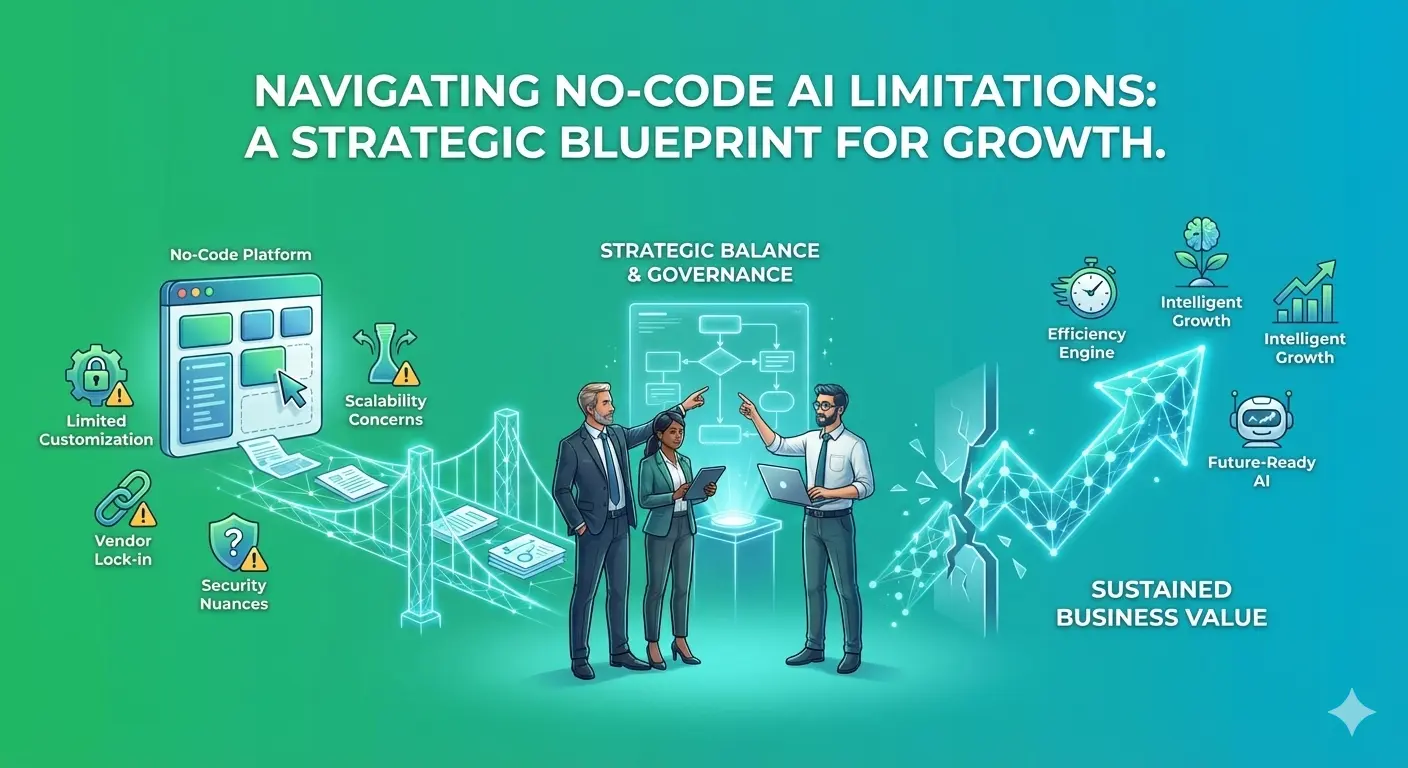
⚠️ Understanding the Nuances: Limitations of No-Code AI
While no-code AI offers significant advantages, operational leaders must also understand its inherent limitations.
 Relevant business metrics.
Platforms should provide actionable status messages throughout the pipeline, from data analysis to model evaluation. The ability to monitor data pipelines and receive alerts in case of issues is fundamental. This immediate feedback loop is critical for iterative AI development, allowing leaders to quickly assess the impact of their AI investments on business KPIs and identify areas for optimization. This fosters a culture of continuous optimization and agility, ensuring AI truly becomes smarter over time and delivers sustained business value.
Key Limitations to Consider:
- Limited Customization: Pre-built components can restrict highly specialized functionalities.
- Scalability Concerns: May struggle under extremely high transaction volumes or millions of users.
- Integration Limitations: May not support every legacy system or custom API.
- Vendor Lock-in: Heavy reliance on a specific platform can make switching difficult.
- Security & Compliance Nuances: Some platforms may offer less granular control over backend security.
These limitations mean that while no-code democratizes AI, it also introduces new complexities. Strategic decisions about when to use no-code and how to manage risks become paramount.
Understanding the Nuances: Limitations and Strategic Considerations of No-Code AI While no-code AI offers significant advantages, operational leaders must also understand its inherent limitations, particularly in complex enterprise environments. A balanced perspective is crucial for strategic deployment.
The modern workspace thrives on agile, cross-disciplinary teams. Developers are transitioning from solo coders to collaborative solution architects, guiding no-code projects. "Citizen developers"—business professionals with deep domain expertise—are empowered to innovate rapidly, supported by technical experts. This transformation is not just about individual empowerment; it's about fundamentally reshaping organizational structures and collaboration models. Operational leaders are uniquely positioned to bridge the gap between core business needs and technical capabilities.
To embark on this transformative journey, start today by identifying one repetitive, data-heavy process in your operations. That is your first target. By systematically following these steps—strategically defining the problem, understanding the pipeline's components, assembling the right no-code toolkit, rigorously prioritizing security and ethical considerations, and committing to continuous testing and iteration—your organization can build powerful engines for efficiency and growth, turning the abstract promise of AI into a concrete, measurable business reality.