Your SaaS Vendor's Secret: You Were Never Paying for Technology

There's a question worth asking about every software subscription on your credit card statement: what are you actually paying for?
Not the marketing pitch — the actual thing. The capability. The outcome. The reason you opened your wallet in the first place.
For most of the AI-feature SaaS tools businesses have been buying over the past four years, the honest answer is this: you were paying for convenience. Specifically, the convenience of someone else figuring out how to use an AI model, packaging it into a tidy workflow, and saving you the trouble of building it yourself.
That convenience has a price. And as of 2026, that price has collapsed.
The Real Product Was Never the Software
Take Jasper, the AI copywriting tool that spent the early 2020s charging $99–$149 per seat per month. What were you buying?
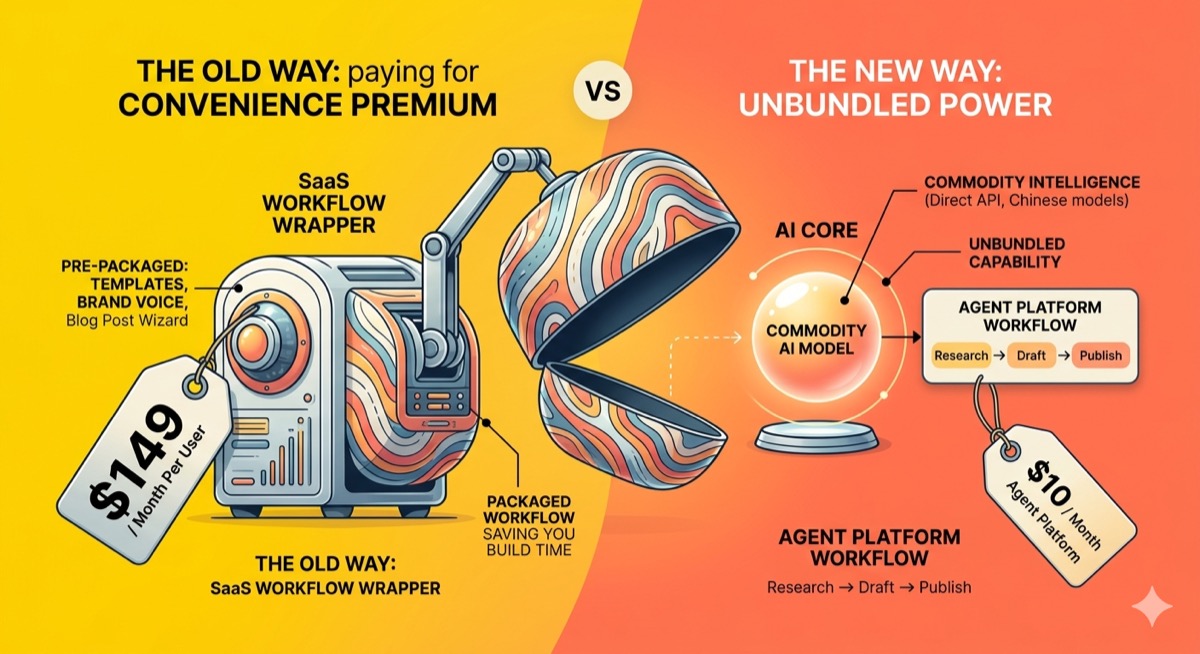 Not access to a language model — GPT-4 was available directly. Not some unique intelligence — the underlying capability was identical to what you'd get from OpenAI's API. What you were buying was pre-packaged workflow: the ad templates, the brand voice feature, the "Blog Post Wizard," the promise that someone had already done the thinking about how to write good marketing copy with AI.
That's the convenience premium. And it applied across an entire generation of SaaS tools: Clearscope for SEO content analysis, Otter.ai for meeting transcription and summarisation, AdCreative.ai for ad variants, Fireflies for follow-up notes. None of these tools had unique AI capabilities. They had unique packaging of commodity AI capabilities — and the market paid handsomely for that packaging.
The model worked because the underlying AI was genuinely expensive and difficult to access. A non-technical business owner had no realistic way to call the OpenAI API themselves, build a brand voice feature, and set up a content workflow. The SaaS wrapper was worth paying for.
That model just broke.
What Changed (And Why It's Permanent)
Two things happened in quick succession that made the convenience premium untenable.
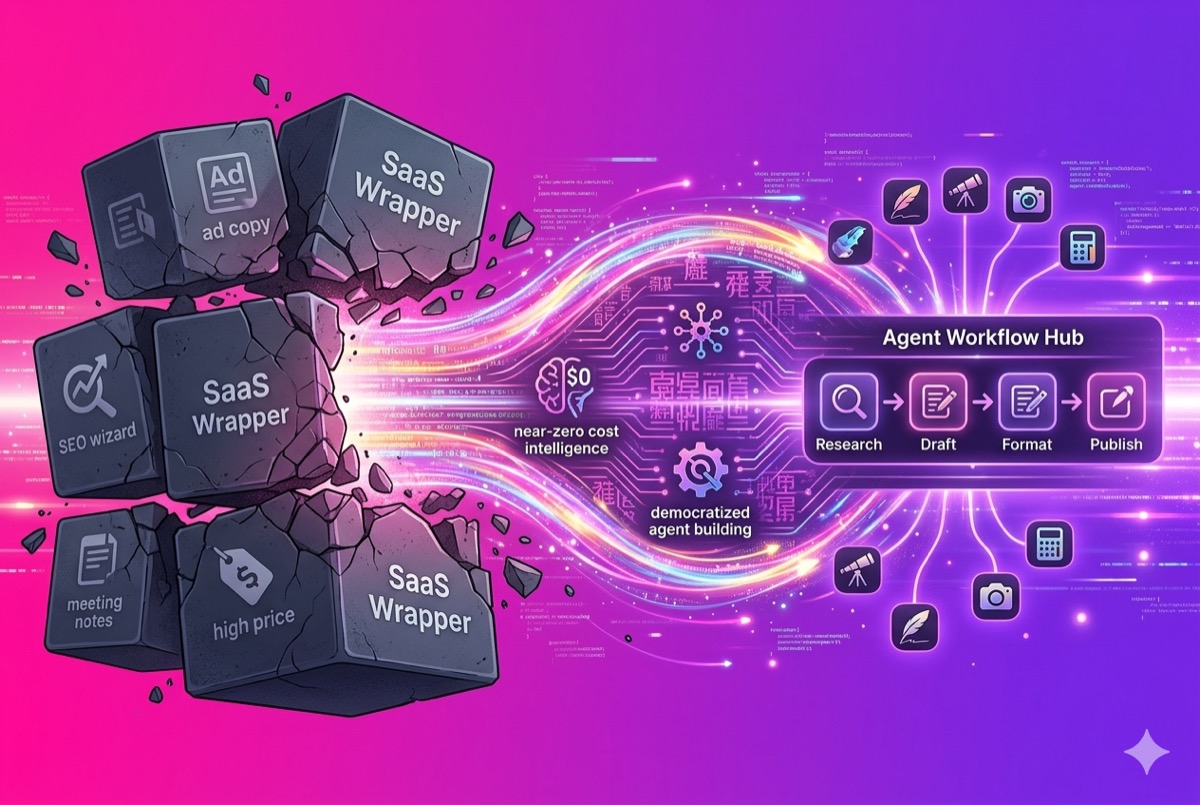 First, Chinese AI labs — Alibaba's Qwen, DeepSeek, Baidu's ERNIE, Moonshot and others — released frontier-quality models at near-zero cost. DeepSeek R1 benchmarks competitively with GPT-4 class reasoning. Qwen handles multilingual tasks at a fraction of Western model pricing. The cost of "the intelligence" dropped to essentially zero for most content and workflow tasks.
Second, the tooling to build agent workflows democratised completely. Where previously you needed a developer to connect an LLM to a workflow, agent platforms now let non-technical users construct multi-step automations — research, draft, format, review, publish — through interfaces that look more like a Zapier board than an IDE.
The combination is decisive. The convenience premium depended on intelligence being scarce and packaging being hard. Neither is true anymore. All-in-one AI workspaces now provide multi-model access plus thousands of built-in templates — including every workflow those specialist SaaS tools were selling — for $10–$30 per month. The five-tool content stack that cost $300/month per user in 2024 runs for less than $30 in 2026.
This isn't a temporary dip. The underlying economics have permanently shifted. The convenience premium is gone.
The Hierarchy That Matters Now
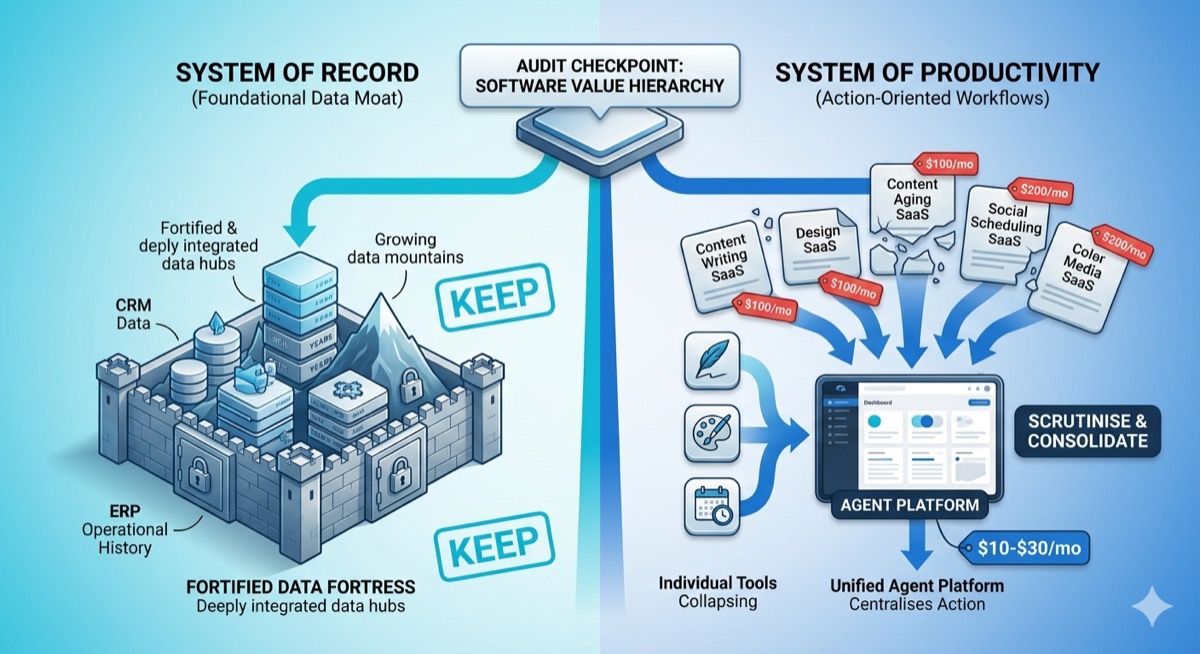
Not all SaaS tools are equally exposed. Understanding why some tools are collapsing while others hold their value requires one clear distinction: system of record vs. system of productivity.
A system of record is where data lives, accumulates, and becomes increasingly valuable over time. Your CRM holds years of customer history, deal notes, email threads, and pipeline data. Your HRIS holds your people data, compensation records, performance reviews. Your ERP holds your financial history and operational data. These tools have genuine moats — the moat is your data, not the software's capabilities.
A system of productivity is where work gets done: content gets written, designs get created, research gets summarised, meetings get transcribed. These tools' value was always in their ability to do something, not to store something.
Agents do things. That's the entire point of an agent. And agents powered by cheap Chinese models or freely available open-source alternatives now do the things that productivity SaaS tools used to charge $100–$200 per seat per month to do.
The practical implication: keep your systems of record, scrutinise everything else.
The Convenience Premium Checklist
Here's a fast way to audit which tools on your stack are in the path of this collapse. For each subscription, answer three questions:
1. Is the core value "it does something with AI"? If the main reason you pay is that the tool generates, summarises, transforms, or suggests content using AI — that's the convenience premium talking. That value is now replicable for cents per task.
2. Would I notice if the AI features disappeared? If yes, you're paying for capability. If the honest answer is "I mainly use it to store things / see a dashboard / manage a process" — the AI bolt-on is a sunken cost and the real value is the system of record underneath.
3. Could a well-configured agent and a good system prompt do 80% of this in one pipeline? If yes — and for most content generation, summarisation, research, and scheduling tools, the answer is emphatically yes — you're holding a convenience premium subscription that your competitors are already cancelling.
Tools that typically fail all three tests: AI copywriting suites, SEO content writers, meeting note-takers, ad creative generators, social media AI add-ons, standalone FAQ/chatbot widgets, and any tool whose core pitch is "AI-powered [noun]."
The Vendor Response You Should Expect
Here's something most business owners don't anticipate: when you call to cancel or downgrade, your SaaS vendor will have a new pitch ready.
It will sound like this: "Our AI is trained specifically on [industry/use case] data, unlike generic models." Or: "We have a proprietary feedback loop that improves with your usage." Or: "Our model is fine-tuned on top-performing content in your niche."
Some of these claims are genuine. Most are not. The test is simple: ask for evidence. Ask whether their model outperforms a well-prompted general-purpose model on your specific tasks. Ask what happens to your data when you leave. Ask what the pricing looks like if you only want the underlying system of record — the database — without the AI layer.
Vendors who have real defensibility will have real answers. Those who don't will pivot to lock-in arguments: integrations, switching costs, team onboarding time. Those arguments deserve to be weighed honestly — but they're not the same as the product being irreplaceable.
Renegotiate accordingly. Many SaaS vendors will quietly offer a stripped-down "system of record" tier at a significant discount if you make clear you're routing the workflow layer through your own agent stack.
What the Future Stack Actually Looks Like
The businesses that have made this transition are running on roughly this architecture:
A core systems of record layer — CRM, HRIS, finance, and any regulated vertical tools — where data lives. These are kept and paid for normally. The AI feature add-ons within them are de-prioritised.
A central agent platform — one primary tool that can connect to the systems of record via API, orchestrate multi-step workflows, and route tasks to the right model for the job. This is the $10–$30/month layer that replaces the $200–$400/month stack.
Deliberate model routing — generic content tasks (drafts, summaries, translations, research) run on cost-optimised models, including Chinese-origin ones where data sensitivity allows. Client-facing or regulated work runs on compliant Western infrastructure with clear data handling policies.
This isn't a complicated architecture. It's simpler than the 8-tool stack it replaces. The complexity most businesses added over the past four years was the price of the convenience premium — all those separate interfaces, separate logins, separate team onboarding processes for tools that were ultimately doing the same thing.
The Action Before Your Next Billing Cycle
Pull your software subscriptions. For each AI-feature tool on the list, ask the single most honest question: am I paying for a system of record, or am I paying for the convenience of having someone else wrap an AI model?
If it's the latter, the price you're paying is a relic of a world where that convenience was genuinely scarce. That world ended.
The businesses consolidating now aren't just saving money — they're building internal agent operations capability while their competitors are still funding convenience premiums for capabilities they could own outright.
That capability gap compounds. Start this billing cycle.
Summary
The real value of most AI-feature SaaS tools was never the underlying technology — it was the packaged convenience of pre-built workflows on top of commodity AI. Chinese AI models from DeepSeek, Qwen, and Alibaba, combined with democratised agent platforms, have made that convenience replicable for $10–$30/month, collapsing the $100–$200/month "convenience premium" that specialist SaaS tools depended on. The key distinction going forward is systems of record (keep them — your data is the moat) versus systems of productivity (scrutinise them — agents now do this cheaper). Businesses should audit their stack using three questions: Does the tool's value live in AI-generated content? Would I miss the AI features more than the data? Could an agent do 80% of this in one pipeline? When renegotiating, push vendors toward database-only tiers and watch for defensibility claims that don't hold up to scrutiny. The future stack is simpler: systems of record + one central agent platform + deliberate model routing.
FAQ
Q: Isn't there still value in a purpose-built SaaS tool that's been fine-tuned for my industry?
There can be — but verify it rather than assuming it. The test is whether the tool actually outperforms a well-prompted general model on your specific tasks, not whether the vendor claims it does. In most cases, a general-purpose agent with a detailed system prompt, your brand guidelines, and a few examples of good output will match or exceed a "fine-tuned" tool that's actually just a generic LLM with a specialised UI. The burden of proof has shifted to the vendor.
Q: Won't my team lose efficiency by moving away from polished SaaS tools to a more DIY agent setup?
Short-term, possibly — there's a configuration and onboarding cost to setting up agent workflows. But businesses report that once the agent is configured, it outperforms the SaaS tool because it can be customised exactly to how your team works, rather than being constrained to the vendor's opinion of best practice. The time to configure a good agent workflow for, say, content production is typically measured in hours, not weeks.
Q: What about the risk of relying on cheap Chinese AI models?
The practical framework: use Chinese-powered tools for generic, non-sensitive workloads — internal content drafts, research summaries, bulk text generation. For anything involving client PII, regulated data, or work covered by specific contractual terms, use a compliant Western-infrastructure stack. Make this decision deliberately and document it. The risk is real but manageable; what's not manageable is paying a 10× convenience premium to avoid a conversation you should be having anyway.