You're Paying $200/Month for Tools Chinese AI Just Made Free
There's a conversation happening in boardrooms, startup Slack channels, and solo founder communities that most business owners haven't caught up with yet.
While you've been using Jasper to write ad copy, Buffer to schedule posts, and Clearscope to optimise your SEO — Chinese AI labs have quietly shipped models and agent platforms that do all of it for $10 a month. Sometimes for free.
This isn't a future prediction. It's already happening. And the businesses that figure it out this quarter will have a significant cost and speed advantage over those that don't.
Here's what's changed, which tools are now obsolete, and the exact framework to audit your stack before your next billing cycle.

The Shift That Changed Everything
For the past decade, SaaS pricing was built on a simple premise: we package the workflow, you pay a monthly fee. Jasper wasn't selling an AI — it was selling "AI that writes ads, with templates, a nice UI, and a brand voice feature." That packaging justified $99–$149 per seat per month.
The underlying capability — a large language model generating text — was expensive and hard to access. The SaaS wrapper was the product.
That model just broke.
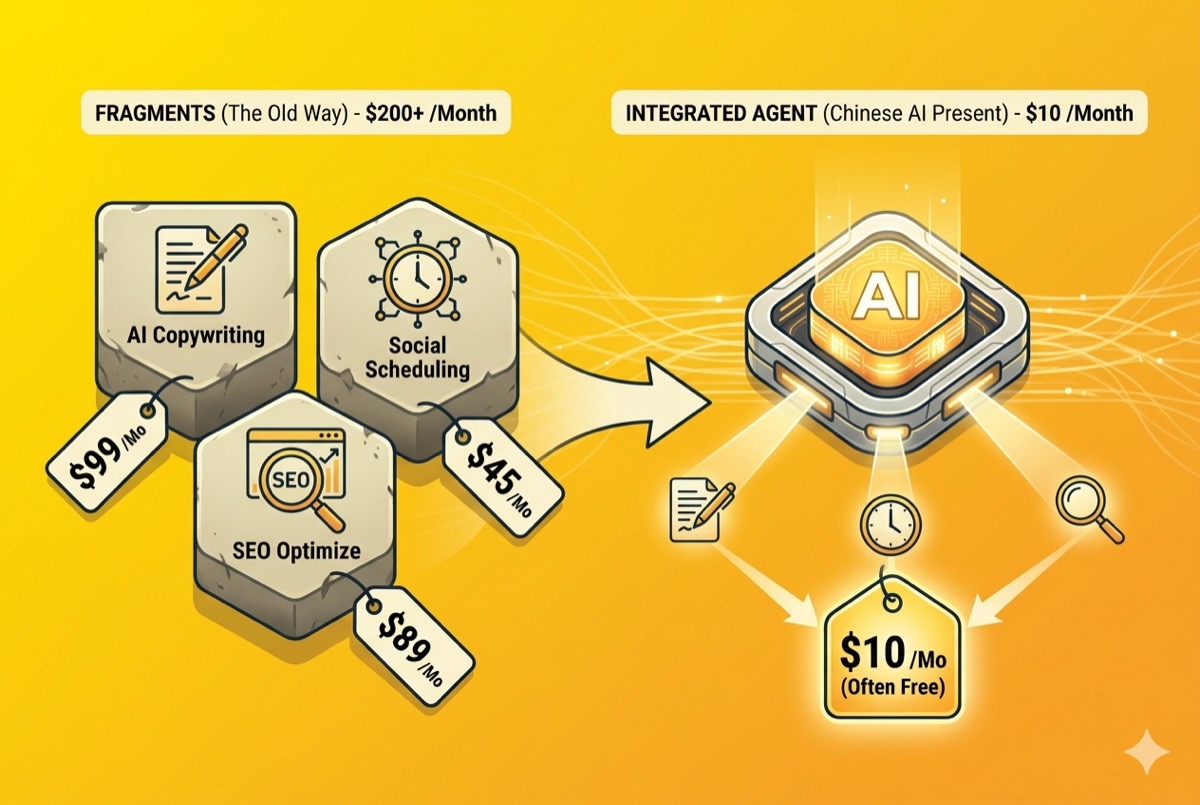
Models like DeepSeek R1, Alibaba's Qwen, Baidu's ERNIE, and Moonshot are now freely available, and in many cases genuinely competitive with GPT-4 class models on reasoning, coding, and content generation. More importantly, agent platforms built on top of these models can orchestrate multi-step workflows: research → draft → format → schedule → post. In one run. For cents.
Industry analysts are describing this shift as SaaS moving from "system of productivity" to just a system of record — while agents do the actual work on top. That's not a metaphor. It's a business model collapse for a specific tier of software.
Which Software Categories Are Being Hollowed Out
Not every SaaS tool is at equal risk. The disruption is concentrated in categories where the product's core value is "it uses AI to generate or transform content" — not in tools where the value is compliance, data storage, or deep integration.

High risk — these are being replaced right now:
AI copywriting and SEO content tools (Jasper, Copy.ai, Writesonic, Surfer SEO, Clearscope, Frase). The entire value proposition of these platforms is "AI that writes and optimises content." General-purpose agent stacks with a good system prompt and your brand guidelines now outperform most of these — at a fraction of the cost.
Social media and content ops tools (Later, Buffer, Hootsuite's AI tiers, Publer). Scheduling itself is table stakes; the AI differentiation layer — captions, repurposing, creative variations — is now replicable by any competent agent hooked into the platform APIs.
Ad creative and design utilities (AdCreative.ai, Thumbnail generators, Canva Pro for AI features). Agents can now script, generate, and iterate visual assets using open or Chinese image models for $0.01–$0.05 per image.
Sales outreach and enrichment add-ons (email sequencing tools, LinkedIn personalisation layers, AI features bolted onto base CRMs). Agentic workflows can do personalised research, draft, and queue outreach in a single pipeline.
Meeting note-takers and document summarisers (Otter.ai, Fireflies, Notion AI, the AI writing add-on for every SaaS that bolted on ChatGPT). These are thin wrappers around transcription and LLM summarisation. A central agent connected to your calendar, inbox, and storage does this natively.
AI helpdesk widgets and FAQ bots (standalone chat widgets without deep backend integration). Replaceable by an agent tied directly to your knowledge base and ticketing system.
The Real Numbers: $100–$200/Month → Near-Free
The pricing gap isn't marginal. Here's what the math actually looks like for a typical SMB or agency.
A standard content and marketing stack in 2024 might have looked like: Jasper ($99/mo) + Surfer SEO ($89/mo) + AdCreative.ai ($49/mo) + Otter.ai ($16/mo) + a social scheduling tool ($45/mo). That's roughly $300/month per user for AI-assisted content operations.
In 2026, the equivalent capability — plus more — runs through a single agent workspace for $10–$30/month. All-in-one AI bundles (think AiZolo-style platforms) provide multi-model access across ChatGPT, Claude, Gemini, and multiple Chinese models plus 2,000+ built-in task templates, for under $10/month. The effective savings for a power user is 70–85%.

Agencies report doing the work of teams that were 2–3× their current headcount by routing tasks through autonomous agents instead of individual SaaS seats.
For enterprises, the shift is even sharper. When an agent can execute tasks across systems, you no longer need a SaaS seat for every junior employee who used to run the tool manually. Internal teams describe buying a fraction of prior licence counts.
Your SaaS Audit: What to Cancel, Downgrade, or Keep
Here's the framework to audit your own stack. It takes about 30 minutes and should be done before your next billing cycle.
Step 1: List every SaaS subscription with three columns
- Tool name and monthly cost
- Core job-to-be-done (what problem does it actually solve?)
- Primary user and estimated weekly usage time
Step 2: Flag anything where 70%+ of the value is AI-generated content or summarisation
This is your high-priority cancellation list. If the main reason you pay for it is "it uses AI to write, summarise, or create," that value has been commoditised. You're paying for packaging, not capability.
Step 3: Apply the rule — System of Record vs. System of Productivity
Cancel or downgrade aggressively:
- Pure AI copywriting/SEO writing tools
- Meeting note-takers and doc summarisers that are just LLM wrappers
- Standalone ad creative and thumbnail generators
- Social scheduling tools where AI is the only differentiating feature
- AI chat widgets without deep backend integration
Keep (these have genuine moats):
- Core CRMs (HubSpot, Salesforce) — your data lives here; agents run on top of these
- ERP, finance, inventory, HRIS platforms — compliance and audit trails are the product
- Vertical tools in regulated industries where certification is the value
- Developer tools with deep workflow integrations that would be painful to rebuild
Step 4: Renegotiate your remaining contracts
For tools you're keeping, use your new agent capability as leverage. Push vendors off per-seat pricing toward usage or outcome-based models. Many will offer a "system of record" tier — database-only access — at a significant discount if you're no longer using the AI feature layer.
How to Consolidate: Choosing Your Agent Platform
Once you've cancelled the excess, you need one central agent platform to replace the workload. The key criteria:
Integration depth — can it connect to your existing systems of record (CRM, inbox, calendar, ad platforms, project management)?
Multi-step orchestration — can it run a full workflow end-to-end without human intervention at each step?
Model flexibility — can it route tasks to the right model based on cost and capability? (You don't need GPT-4 class for a tweet caption.)
Data handling — where does your data go, and what are the residency implications?
Practically, most SMBs are landing on a Western-fronted agent platform (Claude, GPT-4, or Gemini as primary reasoning) with Chinese models handling high-volume, cost-sensitive tasks (bulk content generation, translation, classification). This hybrid gives you capability without unnecessary data exposure on sensitive workloads.
The China Exposure Question
This is the part most posts skip, so let's be direct.
Chinese AI models are genuinely strong. DeepSeek R1 benchmarks competitively with frontier Western models on reasoning and coding. Qwen handles multilingual tasks exceptionally well. For generic content generation, summarisation, and research, they're cost-competitive and capable.
The risks are real and worth quantifying, not just fearing:
Data residency — if your business handles regulated data (healthcare, finance, legal, government), running it through Chinese-origin models raises compliance questions even if you access them through a Western API wrapper. Know where data is processed, not just where the interface lives.
Client contract terms — some enterprise clients or regulated counterparties explicitly restrict third-party AI vendors. Check your MSAs before routing client work through any AI tool, Chinese or otherwise.
Export controls and geopolitical risk — the regulatory landscape is shifting. A tool that's freely accessible today may face access restrictions.
The practical answer for most businesses: use Chinese-powered tools for generic, non-sensitive workloads (internal content, research summaries, first-draft creation). Use compliant Western infrastructure for anything involving client PII, financial records, or regulated data. Document your decision so you can show due diligence if asked.

If You're Building SaaS, Read This Carefully
The same dynamics that should prompt you to cancel subscriptions should prompt SaaS founders to rethink their product.
If your product is primarily UI and workflow logic layered on top of an LLM — without proprietary data, deep integrations, or a compliance moat — you are in the path of a pricing collapse. Your customers are running this audit right now.
The viable paths forward:
- Become the system of record (where data lives and accumulates value over time)
- Become infrastructure (the API or integration layer agents call into)
- Build agent-native (design your product to be used by autonomous agents, not just humans clicking through a UI)
- OEM cheap models to deliver more value per dollar before your competitors do it first
The SaaS companies that are thriving into 2027 will be the ones that treated the agent shift as a platform opportunity rather than a threat to defend against.
The Action This Week
Here's what to do before Friday:
- Run the 30-minute audit — list your stack, apply the 70% AI-value test, flag your cancellation candidates
- Pick one agent platform to consolidate into — something with model flexibility and integration into your core tools
- Cancel or downgrade the top 2–3 tools on your list this billing cycle — you'll likely recover $50–$150/month immediately
- Make a deliberate decision about your China exposure — which workloads are fine, which require Western/compliant infrastructure
The businesses that move on this now won't just save money. They'll build internal agent operations capability while their competitors are still paying for tools that have already been commoditised.
That capability gap compounds.
Summary
Chinese AI models and agent platforms — from DeepSeek, Qwen, Alibaba, and Moonshot — have commoditised the core value proposition of a wide range of $100–$200/month SaaS tools. Categories hit hardest include AI copywriting suites, SEO content tools, ad creative generators, meeting note-takers, and social media AI features. SMBs running proper audits are finding 70–85% cost savings by consolidating into a single agent platform at $10–$30/month. The strategic response: run a SaaS value audit to flag any tool where 70%+ of value is AI-generated content, cancel or downgrade those, consolidate into one central agent stack, keep your systems of record, and make a deliberate decision about Chinese model exposure based on data sensitivity. For SaaS founders, this is a product-strategy forcing function — tools that are "UI + LLM" without proprietary data or compliance moats are in the path of structural price collapse.
FAQ
Q: Should I cancel all my AI SaaS tools and just use Chinese models directly?
Not necessarily. The right move is to consolidate into one capable agent platform — which may use Chinese models under the hood for cost-sensitive tasks — rather than managing raw model access yourself. You want workflow orchestration, integration with your existing systems, and sensible data handling. The point is to stop paying for 8 separate AI-feature add-ons when one platform covers the same ground for $10–$30/month.
Q: Is it safe to run business data through Chinese AI models?
It depends on the data. For generic, non-sensitive work — internal content drafts, research summaries, social copy — the practical risk for most small businesses is low. For anything involving client PII, financial records, regulated data, or work covered by specific contractual terms, you should use a compliant Western-infrastructure stack. The key is making a deliberate, documented decision rather than defaulting to whichever tool is cheapest.
Q: Which SaaS tools should I definitely keep?
Keep your systems of record: CRM (HubSpot, Salesforce), ERP, HRIS, finance platforms, and any regulated vertical tool where compliance certification is part of what you're buying. Agents work on top of these; you rarely replace them first. What you replace is the layer of AI-feature tools that sit in front of them.